
“There’s Lies, Damned Lies, and Statistics” – Mark Twain
At MW Press, we write a lot of stories. Fantasy web serials, sci-fi short stories, thriller novels, funny picture books. Et cetera. Because we’ve worked on so many stories, we’ve learned a lot of lessons when it comes to writing, editing, and even researching.
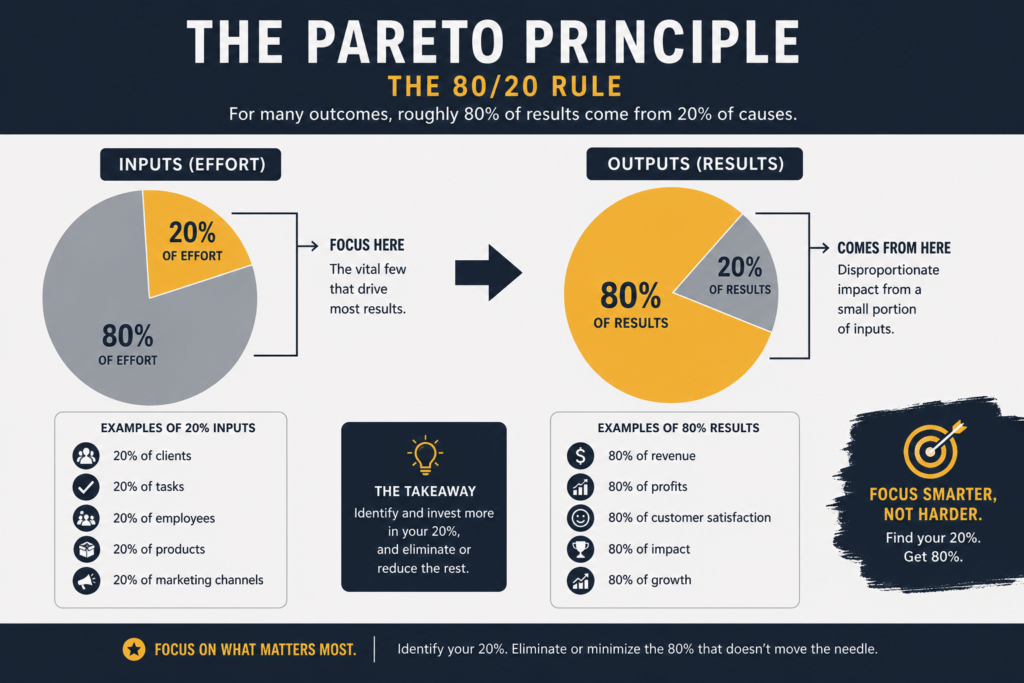
One of the biggest lessons? The Pareto Principle, better known as the 80-20 rule. It essentially states that roughly 80% of your results come from 20% of your efforts. But of course, as is the case with most statistics, it’s more of an estimate than a hard and fast rule.
Better put, the Pareto Principle states that there are a small number of things that we do each day that lead to the most impactful outcomes. Like—cough—sending out newsletters.
By this logic, the opposite is also true. Most of the little things that we do on a daily basis don’t really help us. Best example? Doom scrolling. You do it, we do it, everybody does it from time to time. But it doesn’t actually help us with anything. And of course, there are a lot of similar pitfalls in our particular business.
The 80-20s of Writing
A lot of writers make the mistake of writing, rewriting, and rewriting again when preparing to publish a book. Why? Because they want it to be perfect. And while a book definitely needs to be edited, the idea of spending draft after draft after draft working on the same story is, quite frankly, counterproductive.
Because no book will ever be perfect.
Taken from a grammatical perspective, we can offer some handy numbers. Take, for instance, a 300-page book. Assuming that the average page has 300 words on it (which is the industry standard), that means there are 90,000 words in this book. And if there is 1 error per page, and thus 300 errors in total, you are still 99.997% correct. So is it really worth thousands of dollars or hundreds of hours doing another draft to get from 99.997% to 99.998%? Probably not.
And taken from a plot perspective, there will always be some kind of loose thread. George R.R. Martin’s Game of Thrones is the perfect example because it has a lot of plot holes. A lot of plot holes (We’re looking at you, Bran). Tolkien’s Lord of the Rings has some too (Why not just fly to Mordor on giant eagles instead of walking for three books?). But people still love these stories. We do too. After all, that’s why these are the “Best-Selling Books.” It doesn’t say anywhere that they have to be the best written.
So what is it that we are trying to say in all of this? And why do we care about the Pareto principle? Because it tells us the importance of not trying to be perfect. While we could spend a dozen drafts working on one story, we think it’s better by far to spend an outline and three drafts on each novel, and continue pushing forward.
It’s better to be published than perfect.
So, if there is something that you are holding back on in your own life because you want it to be perfect, here’s your cue (be it a book of your own, a business idea, a trip, or something else): Just do the damn thing.
Until next time.
Best,
Tristan & Blaise