
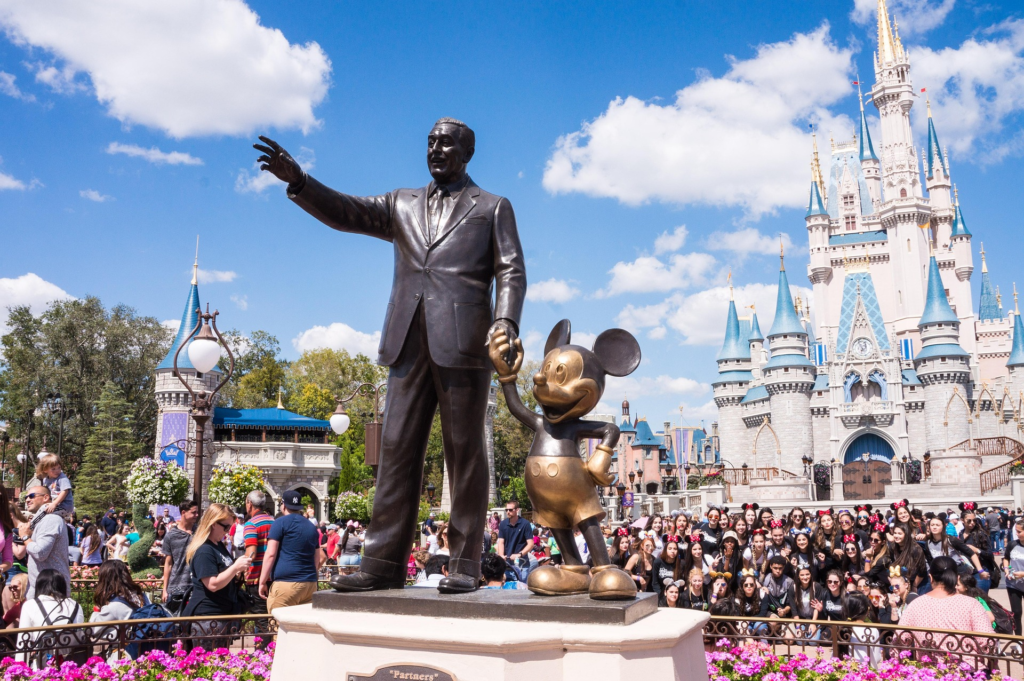
The House of Mouse Really Likes the Cheddar.
How Disney Made Its Money.
Imagine it’s the early 1930s. You are trying to produce a full-length animated movie (which at the time, was a gigantic undertaking—even more than it is now). And you’re strapped for cash, nearly going bankrupt to get this thing off the ground.
Imagine on top of this, you have to actually create a script worth animating and make sure that, after getting all of your loans and investments—even having to mortgage your own home to account for a ballooning budget—you recoup enough profit to land on your feet.
So, what story do you choose to make?
The best answer: a story that’s already popular. Simple marketing idea, but then, how do you select a story you know will be popular? You choose an old one. One old enough that you get the added bonus of not having to pay royalties for it.
Sounds too good to be true, right? It isn’t. Public domain publishing has been around as long as the printing press has been mass producing books. The idea is simple: wait for the copyright on an intellectual property (IP, like a book) to expire and then use it for all your commercial needs.
And that’s exactly what Walt Disney did.
In 1934, Walt Disney’s decided to make the animated movie Snow White and the Seven Dwarfs, a great story, admittedly, but one that was not his own. Snow White was originally a fairy tale published by the Brothers Grimm, published under the name Snow White in 1812. Admittedly, in its original version, Snow White had a darker and more violent ending (i.e., at Snow White’s royal wedding, the wicked stepmother is forced to wear red-hot iron shoes and dance until she drops dead). But again, because this story was in the public domain, he could change the story however he wanted. And he killed off the stepmother in a G-rated way (i.e., off-screen death by falling off a cliff) while allowing Snow White live happily ever after.
And frankly, so did Walt.
He needed $1.5 million to produce the animated movie, which ended up raking in $8 million. So he cashed out with $6.5 million, not having to pay royalties to any writers. Today, that $6.5 million is worth $150 million. And thus, Walt Disney Animated Studios was born.
And considering how well it worked the first time, they used this same option over, and over, and over again. Don’t believe me? Check these out:
- Snow White and the Seven Dwarfs (1937): Based on the Brothers Grimm fairy tale.
- Pinocchio (1940): Based on the novel The Adventures of Pinocchio by Carlo Collodi.
- Cinderella (1950): Based on Charles Perrault’s French folk version.
- Alice in Wonderland (1951): Based on Lewis Carroll’s classic English children’s novels.
- Sleeping Beauty (1959): Adapted from Charles Perrault and the Brothers Grimm.
- Robin Hood (1973): Adapted from English folklore legends.
- The Little Mermaid (1989): Based on the Hans Christian Andersen fairy tale.
- Beauty and the Beast (1991): Adapted from Gabrielle-Suzanne Barbot de Villeneuve’s original French fairy tale.
- Aladdin (1992): Drawn from the Middle Eastern folk tales of 1001 Nights.
- The Hunchback of Notre Dame (1996): Based on Victor Hugo’s gothic novel.
- Hercules (1997): Drawn from ancient Greek mythology.
- Mulan (1998): Based on the ancient Chinese ballad of Hua Mulan.
- Frozen (2013): Loosely inspired by Hans Christian Andersen’s The Snow Queen.
Public Domain Publishing
You might be saying to yourself, big deal. Why does it matter?
Because Disney isn’t the only one doing this.
Penguin-Random House, arguably the biggest publishing house to date, has an entire imprint dedicated to public domain printing, called Penguin Classics. The idea is simple: take public domain works, slap a nice cover on them, add your branding, print the book, and sell it at a premium. Then? Just wait for the money to roll in. And it works! Rather than copywriting the original work, they copyright the translation and introductions so that way people cannot perfectly recreate what they’re doing. That is way they can continually make revenue off these old works.
An example is Marcus Aurelius’s Meditations. The guy died 2000 years ago, but his public domain works are raking in the dough for publishers who seized the opportunity to commercialize his works. The publishers of public domain content don’t have to actually own the intellectual property, they just have to print it. Considering how easy it is to use print-on-demand services these days, it is extremely simple for even independent publishing houses to print these classic tales.
And it’s not just publishers. Filmmakers are doing it. Heard about Winnie the Pooh, the horror movie? Or Bambi the horror movie? These movies are being released in recent years because these titles have just entered the public domain—and as the first people to make horror movies off these popular children’s stories, they are rolling in the dough.
We’re not saying you should make a B-grade horror movie, but we are saying that opportunities abound in the public domain—especially for people who capitalize on that IP first.
Until next time.
Best,
Tristan & Blaise